
Canada Advance Medical Directives
Making an Advance Medical Directive in Canada: A Complete Guide to Planning Ahead

Why Having an Advance Directive in Canada Matters
Most Canadians assume their family will “just know” what to do in a medical crisis. In reality, that assumption often leads to confusion, stress, and conflict at the worst possible time.
Understanding the importance of having an advance directive in place isn’t just about end-of-life planning—it’s about control, clarity, and protecting the people you love from having to make difficult and heart-rending decisions without guidance.
Whether you’re getting up in years yourself or planning for aging parents, a Canadian advance directive is one of the most practical steps you can take. It allows you to prepare ahead of time for serious accidents, chronic illness, and other unforeseen scenarios.
What is an Advance Directive?
An Advance Directive is a legal document that allows a person to make their medical treatment wishes known in advance. It is meant to give guidance to healthcare providers and family members if you become unable to communicate your wishes due to illness or injury.
Depending on the province or territory, an Advance Directive may go by different names. In Alberta, it is called a Personal Directive. In British Columbia, it is called a Representation Agreement. In other provinces, it may be called a Healthcare Directive or a Living Will.
While terminology varies, the core purpose is the same: To ensure that medical decisions made on your behalf reflect your values and preferences.
Why Making an Advance Directive is Important for Canadians
1. You stay in control of your health care.
Without an Advance Directive, decisions about your medical care and treatment may be made by doctors or family members who are guessing at what you would want.
An Advance Directive ensures that (1) your treatment preferences are clearly documented, and (2) your voice is respected—even if you can’t speak for yourself.
2. It reduces stress on your family.
Medical emergencies are overwhelming enough. Add uncertainty to that situation, and family members can struggle with guilt, disagreement, or long-term emotional strain.
Making an Advance Directive removes guesswork, prevents family conflict, and gives loved ones confidence in their decisions.
3. It prevents medical and legal conflicts.
In Canada’s healthcare system, unclear instructions can lead to:
- Disagreements between family members,
- Delays in treatment decisions, and
- Legal complications in extreme cases.
Clear documentation and instructions help avoid these issues entirely.
4. Your values are respected.
Healthcare decisions aren’t just medical—they’re deeply personal. An Advance Directive allows you to express (i) your personal beliefs about quality of life, (ii) your preferences for life-sustaining treatments, and (iii) your unique cultural or spiritual considerations.
5. There are benefits to planning early.
Waiting until a crisis happens defeats the purpose. Creating an advance directive early gives you time to think clearly, encourages meaningful conversations about a difficult subject, and reduces pressure on loved ones later.
It’s not about expecting the worst—it’s about being prepared.
Who Should Make an Advance Directive?
A common misconception is that Advance Directives are only for seniors. But in fact, every Canadian 18 years of age or older should conider making an Advance Directive - particularly if you are a parent or caregiver to a dependent person, or are living with a medical condition, or you just simply want control over your own future.
Remember: Unexpected events don’t discriminate by age.
How to Create an Advance Directive
Step 1. Reflect on your wishes. Think about how you feel about quality versus length of life, life-support measures, and pain management preferences.
Step 2. Choose a person to be your decision-maker. Select someone you trust (such as a spouse, partner, adult child, etc.) to make decisions on your behalf if and when it becomes necessary. MAKE SURE that they are willing to act in this role.
Step 3. Each province and territory of Canada has its own requirements and laws governing advance directives. Choose the form for your province / territory to ensure that it is right for you, and complete it by following the instructions.
Step 4. Discuss your wishes with your decision-maker, your family members, and your healthcare providers.
Step 5. Store and share copies of your Advance Directive. Make sure your decision-maker and your primary physician have copies. Keep a copy on your phone for easy access.
Legal Considerations in Canada
In general, patients in Canada retain the right to refuse consent for any medical procedure for any reason. Health care providers are legally obligated to respect the wishes expressed in your advance directive. However, they are not required to carry out any instructions that are against the law.
Canadian courts have confirmed that advance directives must be respected by health care professionals. If you are uncertain whether your end-of-life instructions are legally binding, you should consult a lawyer in your area for guidance.
Learn more about the legal status of advance directives in Canada.
Frequently Asked Questions
- Is an advance directive legally binding in Canada?
It depends on the province and how the document is created, but most forms are legally recognized when properly completed. - What’s the difference between a living will and an advance directive?
A living will is actually part of an advance directive. - Do I need a lawyer to create one?
Generally you do not need to consult a lawyer to make an advance directive, but you should consider getting legal advice if you have questions or concerns. You should also consider consulting your doctor, to help with medical considerations and terminology. - Can I change my advance directive? Yes. You can update, change or revoke it at any time as long as you are mentally capable.
- Who should I choose as my decision-maker? Someone you trust, who understands your values, and is willing to advocate for you.
- When is the best time to create an advance directive? Ideally now—not during a medical crisis. Don't assume you're too young. Don't assume your family knows what you want. Be sure.
Final Thoughts: Take Control Before You Have To
An Advance Directive should be considered an important facet of every Canadian's estate planning process. It all comes down to one simple idea: your healthcare decisions should reflect your wishes—not someone else’s assumptions.
Creating one isn’t complicated, but the impact is significant. Because when the unexpected happens, clarity is one of the most valuable things you can leave behind.
Learn more about estate planning and making a will in Canada.

Alberta Personal Directive Form
What would happen if you suddenly became unable to look after yourself?
Make your wishes known ahead of time with this Personal Directive form for Alberta residents.
A Personal Directive is an important estate planning form. It is an essential part of every Albertan's future planning portfolio.
In a Personal Directive (sometimes called an advance health care directive or a living will), you can appoint someone you trust as your agent to make personal care decisions on your behalf if you lose the capacity to make those decisions for yourself.
What types of decisions can my agent make for me?
Under the Alberta Personal Directive, you can give your agent detailed instructions and set out your wishes regarding your:
- health care,
- accommodation,
- friends and acquaintances,
- participation in social activities,
- educational activities,
- employment activities,
- legal matters, and
- other non-financial personal matters.
What is included in this Alberta Personal Directive package?
This package is a free downloadable .zip file that is comprised of two forms:
- Alberta Personal Directive Form OPG5521 issued as a fillable PDF by the Government of Alberta, rev. 2020-05, and
- Instruction Sheet for Personal Directives, rev. 2021-12, which gives details instructions to help you fill out each section of the Alberta Personal Directive.
Download your free Alberta Personal Directive Form package today and give yourself and your family peace of mind.
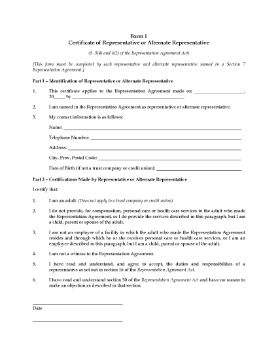
British Columbia Form 1 Certificate of Representative
Download this Certificate of Representative or Alternate Representative if you have made a Section 7 Representation Agreement under the B.C. Representation Agreement Act.
- The Act requires that each representative and alternate representative you named in your Representation Agreement must complete this form before they can act on your behalf.
- This is a prescribed form under B.C. laws.
- Available in MS Word format.
- Intended to be used only in the Province of British Columbia, Canada.
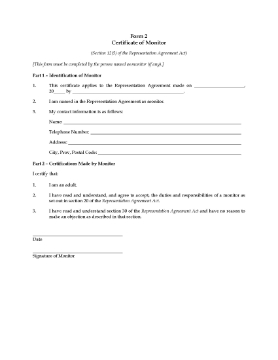
British Columbia Form 2 Certificate of Monitor
Download this Certificate of Monitor if you have named a monitor in a Section 9 Representation Agreement under the B.C. Representation Agreement Act.
- The Act requires that any person you named as a monitor in your Representation Agreement must complete this form before they can act on your behalf.
- This is a prescribed form under B.C. laws.
- Available in MS Word format.
- Intended to be used only in the Province of British Columbia, Canada.
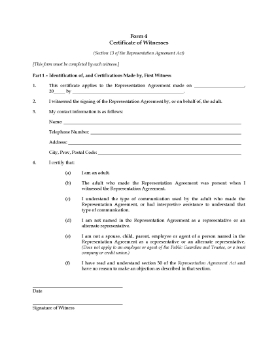
British Columbia Form 4 Certificate of Witnesses
Download this Certificate of Witnesses if you have made a Representation Agreement under the B.C. Representation Agreement Act.
- Section 13 of the Act requires every person who witnesses your signature of the Representation Agreement to complete this form.
- This is a prescribed form under B.C. laws.
- Available in MS Word format.
- Intended to be used only in the Province of British Columbia, Canada.
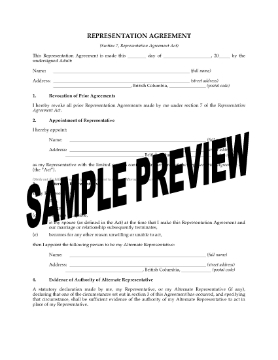
British Columbia Representation Agreement Package (Section 7)
Make sure that your wishes are followed in the event that you become physically or mentally incapacitated, with this Representation Agreement Package (Section 7) for the Province of British Columbia.
- A Representation Agreement allows you to appoint someone you trust as your representative to make decisions for you in the event you become unable to do so. These decisions include medical care, living conditions, personal, financial and legal matters.
- This form is referred to as a Section 7 Agreement, which means that you grant your representative only the limited powers set out under Section 7 of the Representation Agreement Act.
- The package contains:
- Representation Agreement,
- Form 1, Certificate of Representative and Alternate Representative,
- Form 2, Certificate of Monitor,
- Form 4, Certificate of Witnesses,
- Statutory Declaration for Evidence of Authority of Alternate Representative,
- Instructions to help you complete the Section 7 Representation Agreement.
- Available in MS Word format.
- Intended to be used only in the Province of British Columbia, Canada.
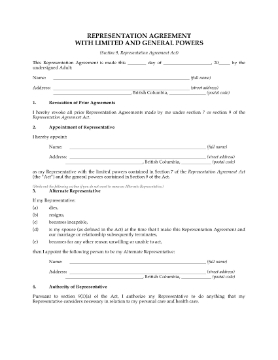
British Columbia Representation Agreement Package (Section 9)
BC residents, make sure that your wishes are followed in the event that you become incapacitated, with this Representation Agreement Package (Section 9).
- A Representation Agreement allows you to appoint someone as your representative to make decisions for you if you are not able to do so. These decisions include medical care, living conditions, personal, financial and legal matters.
- This legal form is referred to as a Section 9 Agreement, which means that you grant your representative the broad and general powers set out under Section 9 of the British Columbia Representation Agreement Act.
- The package contains:
- Representation Agreement,
- Statutory Declaration for Evidence of Authority of Alternate Representative,
- Notes on Completing a Representation Agreement.
- Download the British Columbia Representative Agreement Package (Section 9) and appoint your representative today.
- Available in MS Word format.

Manitoba Health Care Directive
Make your Health Care Directive with this downloadable easy-to-use form for Manitoba residents.
Why do I need a Health Care Directive?
A Health Care Directive (also called a living will or advance directive) ensures that your wishes for medical treatment are followed in the event that you become unable to communicate those wishes due to illness or injury.
How does a Health Care Directive work?
In this document, you can appoint someone you trust to act on your behalf as your proxy and give that person detailed instructions as to what types of medical treatment you want or don't want.
What is included in the form?
The Health Care Directive form includes:
- information and instructions to help you complete the form,
- a Declaration of Incapacity form to be signed by two medical doctors.
Format and Governing Law
This is a downloadable MS Word file, which is easy to fill in and print. There is no need to buy multiple copies for your household. This form can be used by anyone in the family who wants to make a Health Care Directive.
This Manitoba Health Care Directive form was prepared in accordance with the Health Care Directives Act and should only be used by individuals who reside in the Province of Manitoba, Canada.

New Brunswick Advance Health Care Directive
Make sure that your family and your doctor know your wishes for medical treatment in case you become unable to make health care decisions, with this New Brunswick Advance Health Care Directive form.
- An advance health care directive lets you give instructions regarding what types of medical treatment you want or don't want in case you are determined to be incapable of making health care decisions.
- Having a health care directive is crucial if you become unable to communicate your wishes.
- The form also includes information and instructions to help you complete the document.
- No need to buy separate copies for each family member. You can use this form over again as often as you like.
- The form is downloadable and easy to fill in and print. To get yours, just add it to your cart and check out.
- This Advance Health Care Directive form is compliant with the Enduring Powers of Attorney Act (New Brunswick) and is current to January 2021.

Newfoundland Advance Health Care Directive
Make an Advance Health Care Directive with this easy form for Newfoundland and Labrador.
- You can appoint one or more persons to act as your substitute decision maker, to make health care decisions for you if you are unable to do so due to illness or injury.
- You can use this form to give your decision maker detailed instructions and set out your wishes regarding what types of medical treatment you want or don't want.
- You can also give end-of-life instructions on which treatments should be administered to you if you have a terminal illness or are in a permanent coma.
- This form was prepared in accordance with the Advance Health-Care Directives Act of Newfoundland and Labrador and it contains instructions to help you complete each section.
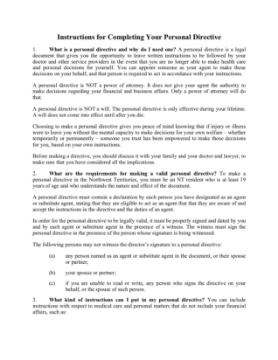
Northwest Territories Personal Directive Form
Make your wishes for end-of-life treatment known by putting them in writing in this Personal Directive form for Northwest Territories.
- A Personal Directive allows you the opportunity to set out your wishes regarding what types of medical treatment you want or don't want, in the event that you are diagnosed with a terminal condition or are in a coma with no real chance of recovery.
- You can name someone you trust to act as your agent to give consent and make medical and personal care decisions on your behalf if you are unable to, due to incapacity or medical condition.
- The form also includes information and instructions to help you complete your Personal Directive.
- Updated 2019 to ensure compliance with the Personal Directives Act.
- This legal document should only be used in the Northwest Territories, Canada.
- 1
- 2